

Manufacture a product in China in 2027
Manufacture a product in China in 2027: how to find and vet a factory, what happens when things go wrong, and which new deadlines belong in your plan.
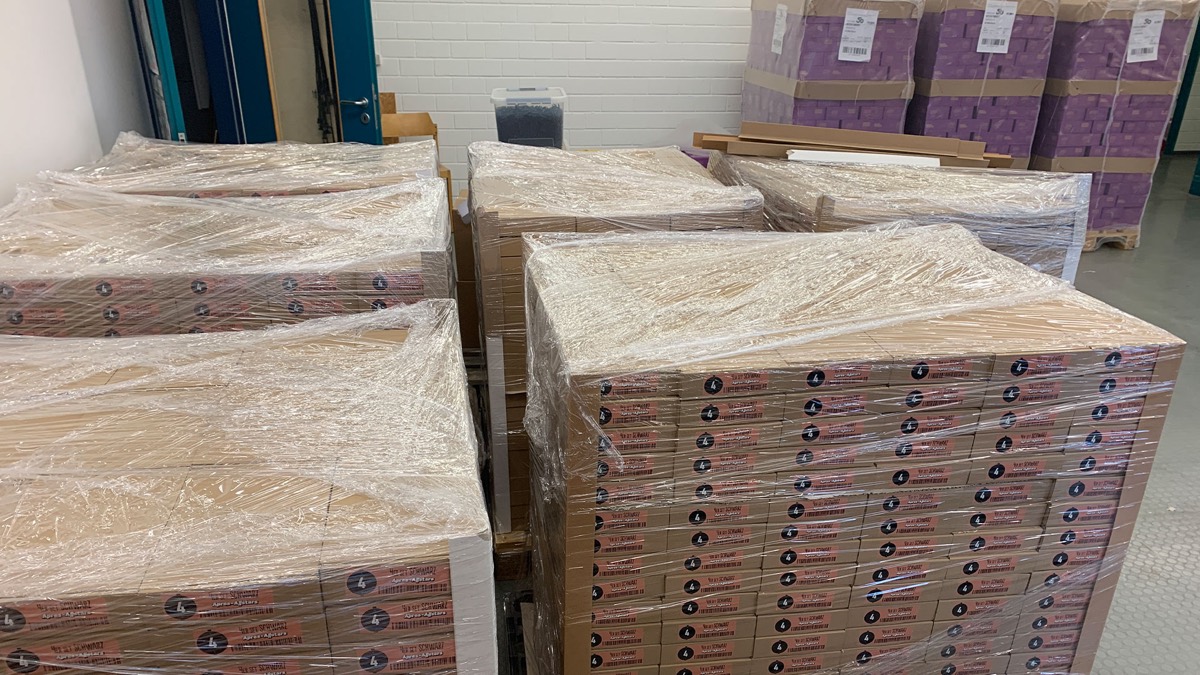
If you want to manufacture a product in China for the first time, you probably look at the unit price first. The real cost sits elsewhere: in the production run that doesn’t look like the sample, and in the deposit that is then gone. I’ve had my inflatable products ShredRack, BOLSTair and Truck Tollo manufactured in volume in Asia. This is what hurts along the way and how I protect myself.
What is contract manufacturing in China? If you have a product made in China, you hire a factory there for series production. The business develops or defines the product itself; it is made either as a complete product under its own brand (OEM or private label) or as individual parts that are assembled in Europe. Responsibility for the specification and quality stays with the client, and so do the obligations when selling in the EU.
💡 Planning your first production run in Asia and want a second pair of eyes on your requirements and supplier choice? Here’s how I work with businesses →
Manufacture a product in China – or stay in Europe?
China pays off mainly for large volumes and for manufacturing technology that is hardly used for volume production in Europe any more. For small quantities, urgent restocking and products with lots of special requests, Europe is often the better choice. I decide on these criteria:
| Criterion | Points towards China | Points towards Europe |
|---|---|---|
| Volume | large runs, mass production | small batches, many variants |
| Manufacturing technology, machinery | processes that only run at volume there | processes available locally |
| Material | available and cheap there | specialist material from Europe |
| Lead time | predictable, weeks of lead time are no problem | restocking has to be fast |
| Customisation | standard product in high volume | frequent changes, special requests |
| Protecting know-how | parts can be split across suppliers | the whole system would have to be disclosed |
In Europe I keep running into capacity limits. Then there’s the technology: a standard factory in Europe often can’t deliver what a standard factory in Asia delivers, and sometimes the manufacturing technology and machinery force you to make the entire run in Asia. Manufacturing know-how hasn’t been limited to Germany for a long time. And “then Eastern Europe it is” works out less often than you’d think: according to a 2026 analysis by Strategy&, nearshoring to Eastern Europe saves hardly any cost.
That’s why our answer is “both”. At Apres Allstars, around 80% of the value is added in Germany, and final assembly is done by sheltered workshops – from the first small batches through to series production, with consistently good results. The inflatable products, on the other hand, are manufactured in volume in Asia. Whether you’re a manufacturer outsourcing a new product or a retailer moving from bought-in goods to your own brand: you decide a lot of this before you contact the first supplier. The reason is in the article on product costs in the early phase.
Want to move from retailer to your own brand? My Manufacturer DNA roadmap is free at the bottom of this article.
What changes in 2026 and 2027: dates and figures
China remains the most important supplier for German businesses, but the rules around it are getting tighter. If you sell into the EU, these dates belong in your planning – the first three already apply:
| When | What | What you should do |
|---|---|---|
| Since 1 January 2026 | CBAM: anyone importing more than 50 tonnes of iron, steel or aluminium goods a year (screws and nuts included) needs authorisation. The first annual declaration for 2026 is due by 30 September 2027. | Work out your annual volume of imported metal parts. |
| Since 1 July 2026 | A €3 customs duty per item on low-value consignments up to €150 from outside the EU. | Hardly relevant for containers, but it is for samples and spare parts sent by parcel. |
| October 2026 | Freight Shanghai–Rotterdam at 3,632 US dollars per 40-foot container according to the Drewry index (22 October 2026). Some services use the Suez Canal again, many still go round Africa. | Always date your freight costs and build a buffer into lead times. |
| 6 February 2027 | Chinese New Year. Many factories wind down weeks in advance; the official holiday schedule for 2027 has not been published yet. | Place firm orders in November or December for goods that need to ship before mid-February, and get the closure dates confirmed in writing. |
| 18 February 2027 | EU Batteries Regulation: portable batteries in products must be readily removable and replaceable by the end user. There are exceptions, for example for devices used in wet environments. | Check built-in batteries in your design now, not at your next order in China. |
The figures behind it: according to the German Federal Statistical Office, Germany imported goods worth 170.6 billion euros from China in 2025, 8.8% more than the year before. China has been Germany’s most important supplier country since 2015. At the same time, according to KfW Research (2026), 12% of internationally active German SMEs plan to move production abroad within the next five years; in manufacturing it is 29%. My conclusion: the route to Asia stays open, but in 2027 it needs more lead time and more paperwork.
If your product has a battery, this deadline takes the most work. Whether a battery can be removed is decided in the housing, the screw connections and the seals – in the design, not in purchasing. That is exactly the kind of redesign I handle in product development. Information on regulations is general and does not replace professional advice.
Find a manufacturer in China: search by process, not by product
I find the best suppliers through recommendations from my network, the second best at trade fairs. For everything else I use Alibaba with a precise request. Before that, though, comes a step many people skip: breaking the product down into manufacturing processes.
Processes first, then the search. Injection moulding for plastic parts, sheet metal fabrication, sewing, plastic film welding, PCB assembly: each one is a manufacturing process of its own. So ask: who really has these processes in-house? A supplier that offers your product but buys in three out of four processes is a middleman with an extra step.
1. Network. In my experience, face still counts in Asia. Nobody likes to lose it, and anyone who was recommended to you through a mutual contact wants to look good in front of that contact. A personal meeting carries more weight there than a signed contract. That’s why I ask my own network first.
2. Trade fairs in Germany. Many good suppliers have the budget and fly to the big industrial and specialist trade fairs in Germany. There they often sit in the sourcing areas: a small, unremarkable booth, five samples on the wall, a name behind it. Behind some of these booths is a factory with thousands of employees and hundreds of production lines. The suppliers know each other well and recommend each other when their processes complement each other. Nobody likes to recommend a direct competitor, though.
3. Alibaba with an RFQ. Alibaba is fast and built precisely for sourcing. If I can’t find a suitable manufacturer there, I post an RFQ (request for quotation, a public enquiry) and describe exactly what I need.
That description is your filter. I always write my requirements in two columns:
- Must: function, material, critical dimensions with tolerances, standards and tests, target quantity per year, packaging.
- Nice to have: colours, finishes, variants, accessories.
The first replies show me how carefully my request was read. Anyone who simply sends me the full catalogue with their entire product portfolio either isn’t interested in me or doesn’t work carefully enough. Either is a reason to move on. At its core, a list like this is a small set of manufacturing instructions a supplier understands. If you’d rather not write it yourself: it’s a fixed part of my product development.
Factory or trading company? Three tests
On platforms you often end up with a trading company without technical expertise that has to pass every question on first. Three simple tests usually let me tell the difference quickly.
- The OEM question. I ask directly: “Are you the manufacturer (OEM)? Do you do private labelling?” The response time is at least as revealing as the answer. If every technical answer only arrives the next day, a trading company is checking with the factory first.
- The sample test. Good, large factories have their sales team in-house. They walk over to production and shortly afterwards send you a photo of the sample or the part you asked about.
- The live call. There’s Wi-Fi everywhere today. Ask for a live video call and have them show you production – specifically the machines that match your manufacturing process.
A look at the register is also worthwhile. Every Chinese company has an 18-digit Unified Social Credit Code; with it you can check the name, status and registered business scope in the state company register (National Enterprise Credit Information Publicity System). The portal is in Chinese and not always reachable from Europe, and the entry shows what is registered, not necessarily what the company does. But if it lists only trading and no production, you should ask more questions. A “Verified” badge on a platform doesn’t replace this check.
Samples and the golden sample: start with small batches
Start with a small batch and check it against the golden sample – the last approved sample sitting on your desk. What gets really expensive is a production run that deviates from it: then you have to claim against the supplier, and that gets unpleasant.
My protection against this has two parts:
- Requirements specification and inspection checklist. The must-haves become the requirements specification (or functional specification). From it I derive the checklist for the pre-shipment inspection, with exactly the dimensions that really matter. That way I rarely see a major defect.
- Increase batch sizes step by step. A small quantity first, then work your way up. Each batch shows whether the run holds to the sample before a lot of money is tied up in it.
I’ve instructed and signed off production in Asia myself, first as a developer and today for our own brands. When a business places its first production run, I go through exactly these steps with them.
Deposits and defective goods: what happens when things go wrong
When things go wrong, the deposit is usually gone, and defective goods practically never go back. I plan for that from the start.
Payment. The usual terms are a 30% deposit and 70% before shipment. With a new supplier relationship I’ve also seen 50/50: half before production starts, half before delivery.
Defective goods. Whatever can’t be repaired usually stays with you. In practice you get a discount on the next order. That’s not great, because I don’t want to pass poor quality on to my customers at a lower price.
Contract and face. Law firms specialising in China recommend an NNN agreement (non-disclosure, non-use, non-circumvention) under Chinese law and in Chinese, because a contract with German jurisdiction is of little help there in a dispute. That’s sound advice. In my practice, though, face still counts for more. You find out whether a supplier is serious the first time something goes wrong: if they admit the fault and send a free replacement instead of just a discount, you have a partner.
Protecting know-how: tooling, trademarks, copies
Tooling you’ve paid for practically never moves in Asia, and paper protects your know-how there only to a limited extent. That’s why I split production and keep bringing out new products; I price in the tooling risk.
Tooling. You pay for the tooling, but the mould sits in the factory. It only belongs to you anyway if that’s agreed in writing. And even then, hardly any supplier in Asia will go along with a move to another manufacturer, as is common in Germany. On top of that, the mould is often designed for exactly that machine. I live with this risk and price it in from the start, not only when the supplier raises prices.
Splitting. I rarely have the entire product configuration made by one manufacturer. Wherever possible, I split parts, raw material and assembly across several suppliers. For me that’s the most effective protection, and it has a price: more suppliers and interfaces, extra freight and my own final assembly. And when something goes wrong, they like to point at each other. There’s a limit, too: a supplier often needs the adjacent parts to understand how the product works and to get their tolerances under control. Then splitting no longer works.
Trademarks. China grants trademark rights on a “first to file” basis. A trademark registered in Germany or the EU is not protected in China; the EU’s China IP SME Helpdesk therefore advises registering trademarks there early. We haven’t registered our trademarks in China so far, because we don’t serve the Chinese consumer market. Whether that’s enough for your product is something to clarify with a trademark attorney; this article doesn’t replace legal advice.
Copies. The people who copied me were people I’d worked with closely. A typical case is a production manager who leaves and sets up their own company. That’s bitter. Even so, the copy didn’t succeed; I watched the company behind it go under. It didn’t have the original’s marketing and service. That’s what I rely on, along with a steady stream of new products: if you keep developing, you usually stay one version ahead of the copy.
Shipping and landed cost
What constantly wears on my nerves when manufacturing in Asia is shipping. It has become slower and more expensive in recent years, and every shipment needs more coordination. Sending a parcel or a few pallets by lorry within Europe is in a completely different league.
So base your calculation on the landed cost, the cost all the way into your warehouse, not on the ex-works price. That includes freight, customs duty, insurance, storage and the money tied up on the water for weeks. In Germany, a business entitled to deduct input VAT can reclaim the import VAT, but it still has to pre-finance it. I’ve summarised packaging, Incoterms and financing in the guide to starting production.
Obligations when selling in the EU. If you sell to consumers in the EU, the General Product Safety Regulation (GPSR) has applied since 13 December 2024: consumer products need a responsible economic operator in the EU, and anyone selling under their own brand counts as the manufacturer. This is general information and doesn’t replace professional advice.
So that deliveries don’t get lost in emails and spreadsheets, every delivery sits in my own ERP with its expected date; overdue ones turn red. I build modules like this for businesses under process optimisation.
Your first week with new suppliers
Take your time in the first week and put every candidate through their paces, instead of going with whoever sends the cheapest quote first. I use this list myself:
- Product broken down into manufacturing processes, with several candidates found for each process.
- Must-have and nice-to-have criteria written down and sent to all candidates in the same form.
- OEM question asked and response times noted.
- Photo of the sample requested straight from production.
- Live video call held, with a walk-through of the relevant production area.
- Registry checked.
- Several conversations held with the sales contact: do you understand them, do they understand you?
- First order planned as a small batch, payment schedule and pre-shipment inspection checklist agreed.
- Tooling risk and freight priced into the calculation.
The point about the contact person sounds soft, but it’s hard. Several times I’ve seen a salesperson change jobs and nothing worked any more afterwards. Once we almost had to switch suppliers, and it took a real blow-up before the collaboration was back on track.
You make or sell products, have roughly 10 to 80 people and are facing your first order in Asia? Then the Test Bench is the place to start: a 20-minute phone call, then a day of analysis on site with you and a day of working out the solution, both free of charge. At the end there’s a fixed price for the implementation – or an honest no if it doesn’t pay off.
Frequently asked questions
Is it worth manufacturing a product in China?
For large volumes and manufacturing processes that are hardly used for volume production in Europe any more, usually yes. For small batches, frequent changes and urgent restocking, Europe is often more economical, because freight, lead time and tied-up capital can eat up the unit-price advantage. Always base your calculation on the landed cost all the way into your warehouse, not on the ex-works price.
How do I find a reliable manufacturer in China?
Ideally through recommendations from your own network, then through the sourcing areas of large trade fairs in Germany and through platforms such as Alibaba with a precise request. Search by manufacturing process, not by product. Check every candidate with the OEM question, a sample photo from production, a live video call and a look at the Chinese company register.
How can I tell if a supplier is a factory or a trading company?
By the response time to technical questions, by photos taken straight from production and by a live video tour. A factory with its own sales team answers quickly and specifically; a trading company has to check first. The registered business scope in the company register also gives you a hint as to whether the company manufactures.
Do I need to travel to China to find a manufacturer?
Not necessarily. Many suppliers exhibit at trade fairs in Germany, and you can ask for a tour of production by live video call. In Asia, though, a personal meeting creates a level of commitment that a contract alone doesn’t. For an important production supplier, the trip is therefore worth it.
How much deposit do Chinese suppliers usually ask for?
The usual terms are a 30% deposit and 70% before shipment, sometimes 50/50 with new supplier relationships. Expect the deposit to be lost in most disputes. You can protect yourself with small first batches and a pre-shipment inspection based on your requirements specification.
What changes in 2027 when manufacturing in China?
There are three dates you should know. Chinese New Year falls on 6 February 2027, so orders for goods that need to ship before mid-February belong in November or December. From 18 February 2027, portable batteries in products placed on the EU market must be removable by the end user, with exceptions. And anyone importing more than 50 tonnes of steel or aluminium goods a year submits the first CBAM annual declaration by 30 September 2027.
Sources
Strategy& (PwC) via produktion.de, 2 March 2026: “Nearshoring: Abwanderung nach Osteuropa spart kaum Geld” (in German) · Harris Sliwoski, China Law Blog: “China Manufacturing Payment Terms”, “China NNN Agreements: What They Do, What They Don’t, and How to Get Them Right” and “Who Owns Your Molds?” · China IP SME Helpdesk (EU): FAQ on IP in China · Regulation (EU) 2023/988 on general product safety (GPSR), Art. 3(8) and Art. 16, applicable since 13 December 2024 · German VAT Act (UStG), Section 15(1) sentence 1 no. 2 · National Enterprise Credit Information Publicity System (gsxt.gov.cn) · German Federal Statistical Office (Destatis), press release no. 056 of 20 February 2026 · KfW Research, press release of 6 September 2026 (in German) · Hong Kong Government: general holidays 2027 (gov.hk) · Regulation (EU) 2023/1542 (Batteries Regulation), Art. 11 · Regulation (EU) 2023/956 as amended by Regulation (EU) 2025/2083 (CBAM) · European Commission, announcement of 29 June 2026 on the €3 customs duty · Drewry World Container Index of 22 October 2026 · Maersk customer advisory of 14 September 2026. As of 27 October 2026. Information on law, tax and trademarks is general and does not replace professional advice.
Is your business stuck right here? That's what I solve →