“Too much of our work runs through spreadsheets and emails between people.”
Everyone has their own list, nobody has the overview. On Friday evening someone retypes what somebody else already typed on Monday. That is not an IT problem. It is a process that was never built.
Sound familiar?
Quotes are created from a template everyone fills in differently – and nobody knows which version is current.
Receipts sit in three inboxes, the bookkeeper sorts them by hand, the tax adviser asks questions.
The stock level lives in a spreadsheet that is right until someone forgets to update it.
When one person is ill, a whole workflow stops, because only they know how it works.
You have already looked at an off-the-shelf system – and it did not fit, because your business works differently.
What you end up with
A tool that takes over exactly the one process that costs the most – not the whole company at once. With a clear handover to your team or to developers, so you do not depend on me. The first tool is usually in use within a few weeks, and the benefit is stated in euros in the estimate beforehand.
How I work
Three steps, no project theatre.
01
Look at the one process
Not the company, the process. On the Test Bench day I walk through it with the people who do it every day – from the first email to the last filing.
02
Work out whether it pays
Hours per week, cost of errors, waiting times. That becomes a number per year. If it is too small, I say so and we leave it.
03
Build, hand over, let go
A building block that takes over the process. Fixed price. Documented, so your team or a developer can carry it on. A small maintenance contract if you want one.
In my own business
This is exactly how I solved it in my own company.
My ERP
Orders, stock, invoices, suppliers for two product companies. No off-the-shelf system fitted, so I built it myself. Runs daily.
The receipt bot
Reads inboxes, recognises receipts, matches them, hands them to the accountants. Developed with Michi Gasteiger – now in production in two companies.
Use case · my ERP
This is what a tool looks like that fits the business.
No off-the-shelf system fitted my business, so I built it myself. These are the five areas we work with every day at Apres Allstars.
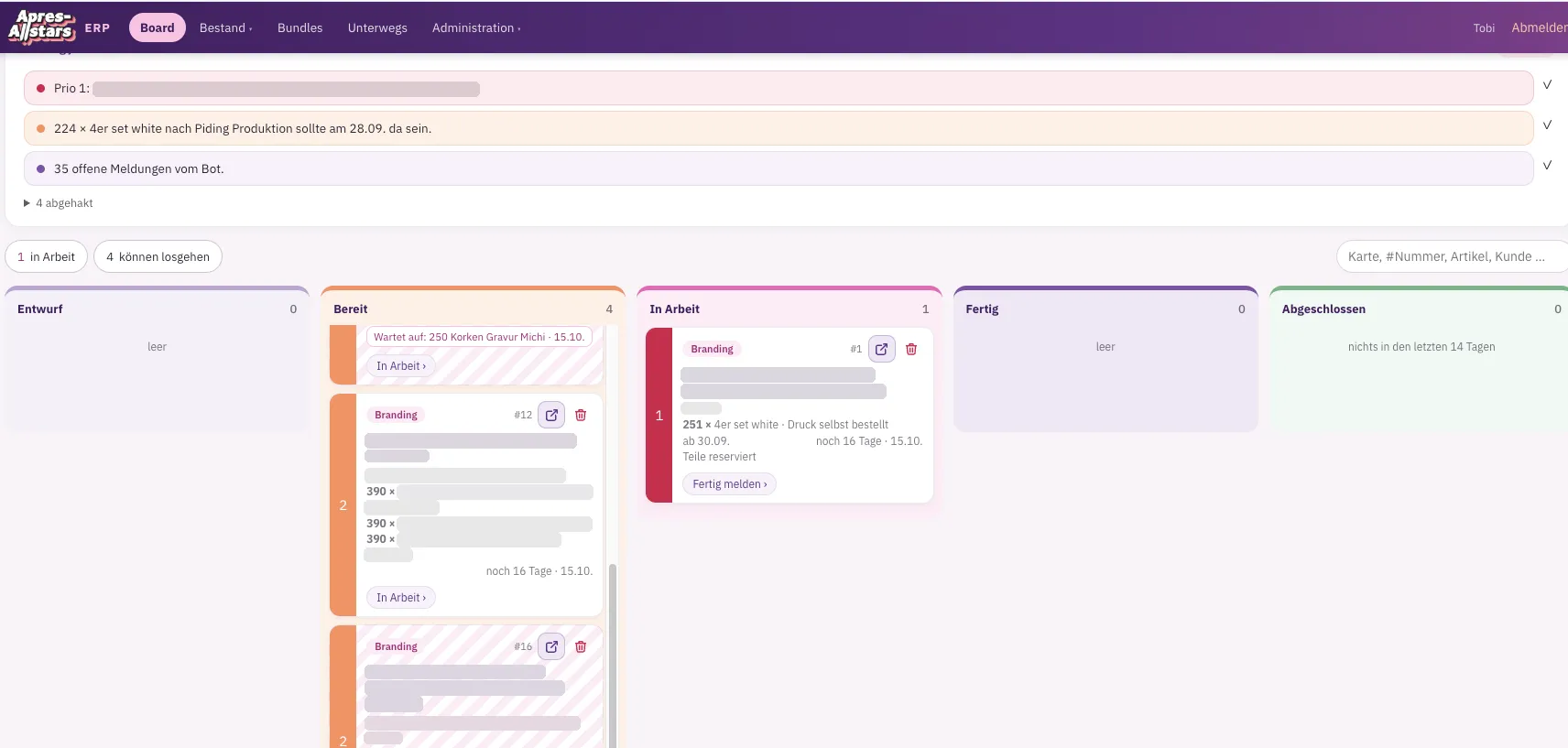
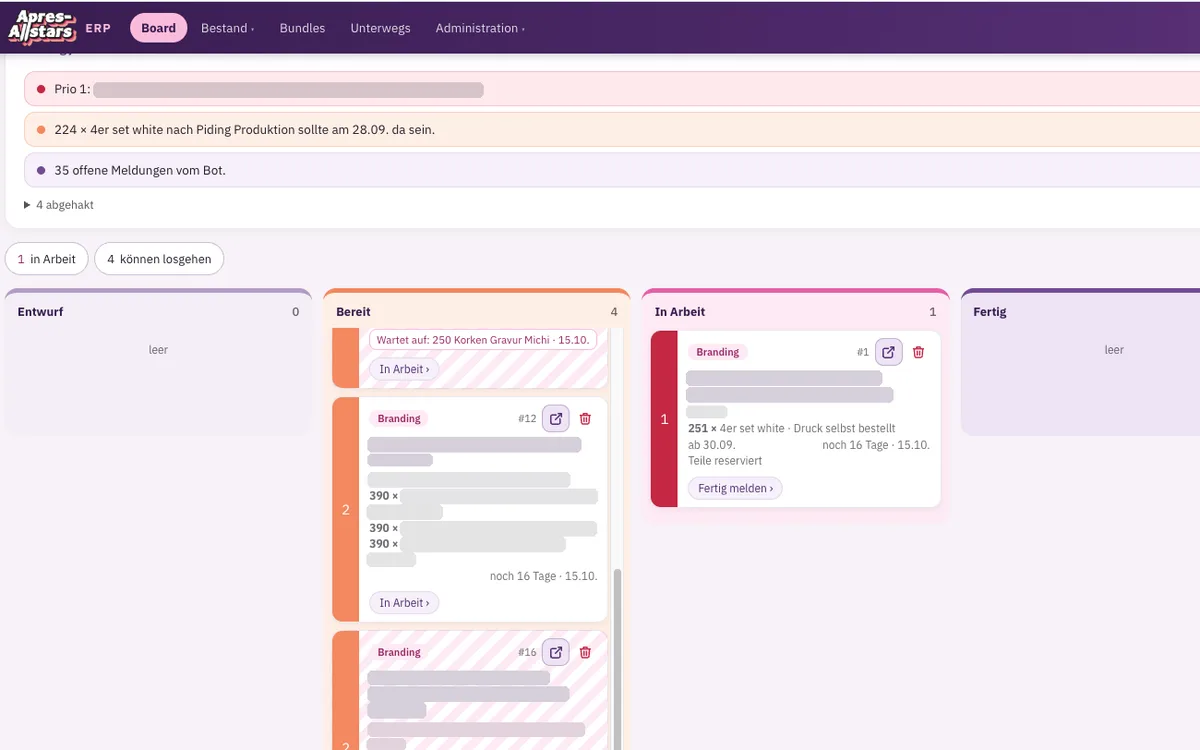
01 · Order board
All orders at a glance
Every order is a card and moves from draft through ready and in progress to completed. At the very top is what needs doing first today.
Priorities, overdue deliveries and open notifications are at the top
Each card shows quantities, required parts and the deadline with days remaining
You can see whether parts are reserved or what the order is still waiting for
ERP · Order board
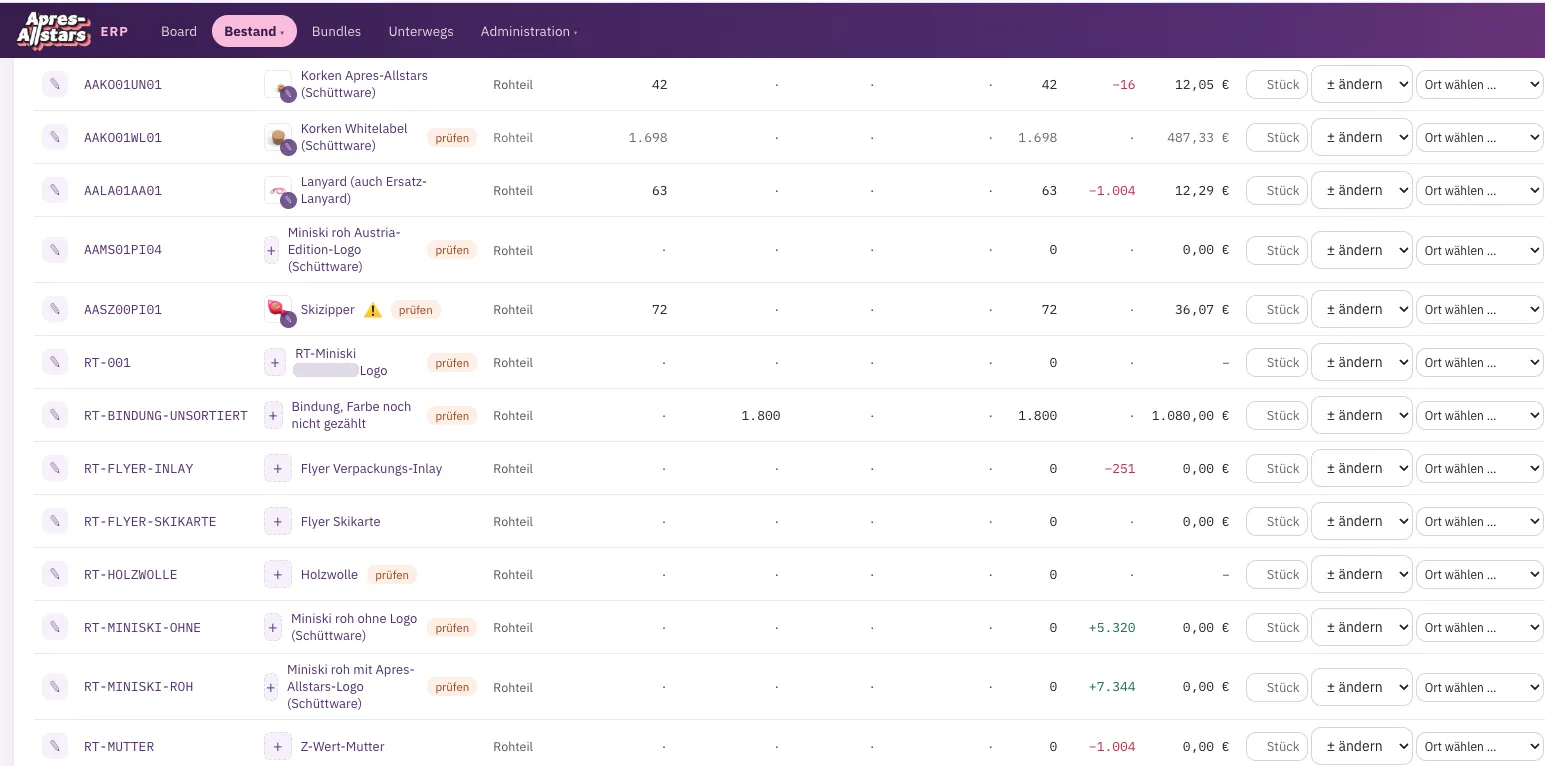
02 · Stock
A stock level that is right
All articles and raw parts with quantity per storage location, total stock and stock value. Bookings are made directly in the row.
Book quantity, location and comment in one step
Articles that need checking are flagged
Plus monthly levels, notifications and suggestions as separate views
ERP · Stock
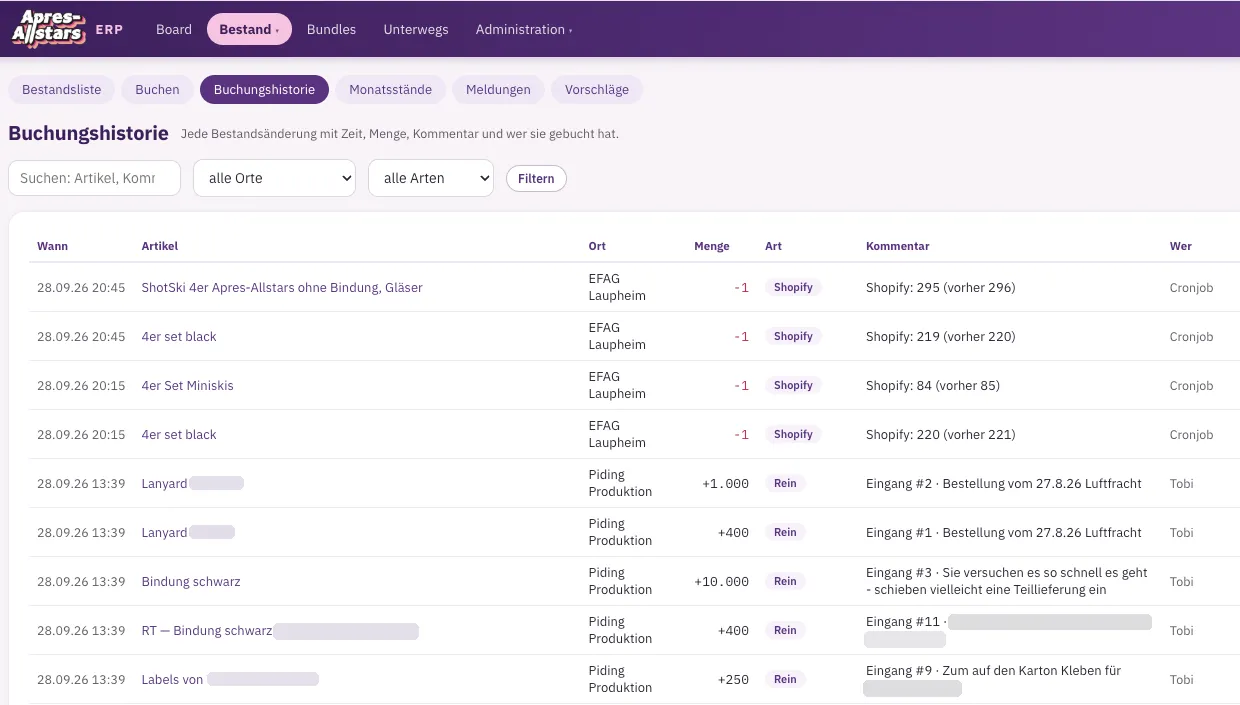
03 · Booking history
Who booked what, and when
Every stock change is recorded with time, quantity, comment and person. Sales from the Shopify shop are booked out by the system itself.
Shopify sales flow into stock automatically
Goods received are listed with number and comment
Your own bookings can be undone
ERP · Booking history
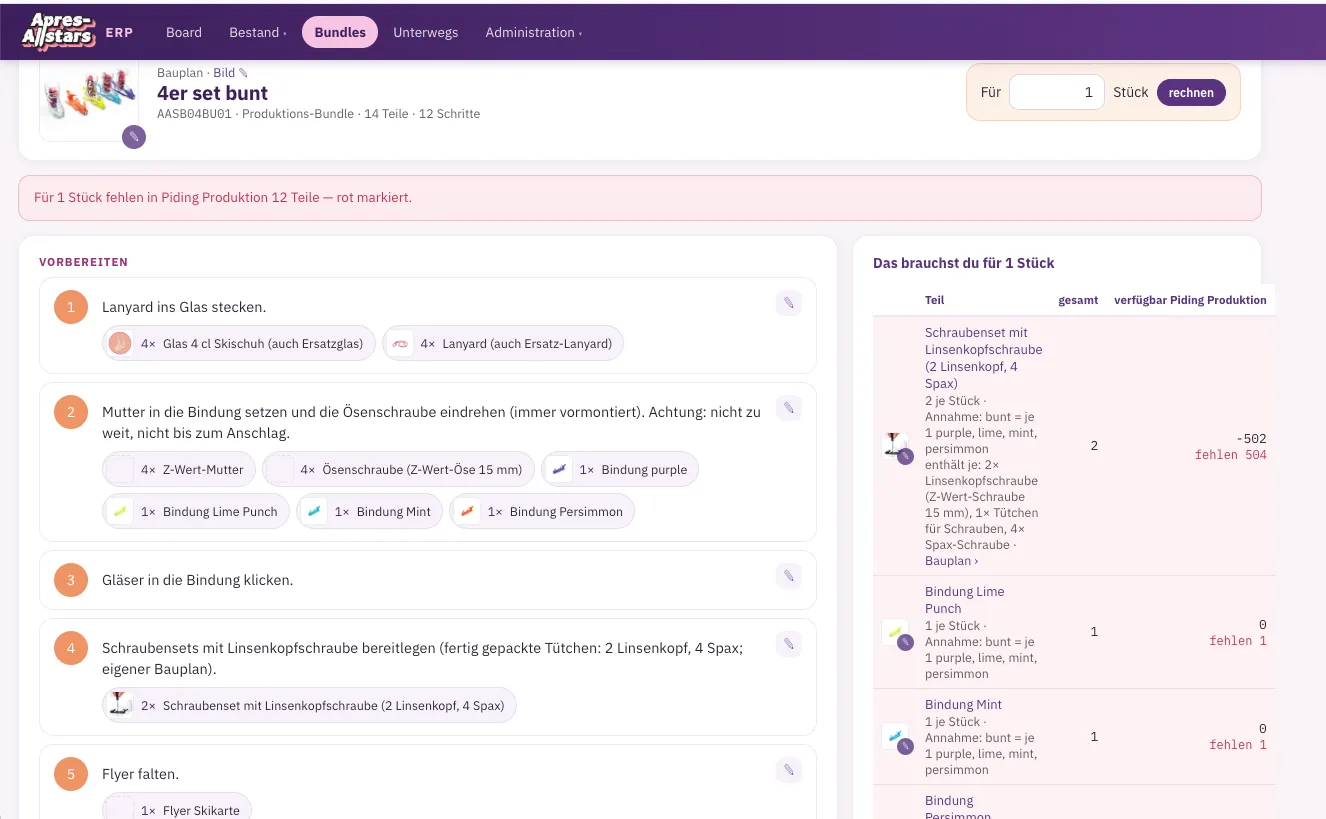
04 · Build plans
From single part to finished set
Every set has a build plan: step by step, with exactly the parts needed in that step.
Enter the quantity and let it calculate
The system shows what is available and what is missing – marked in red
Nobody has to keep in their head how a set is assembled
ERP · Build plans
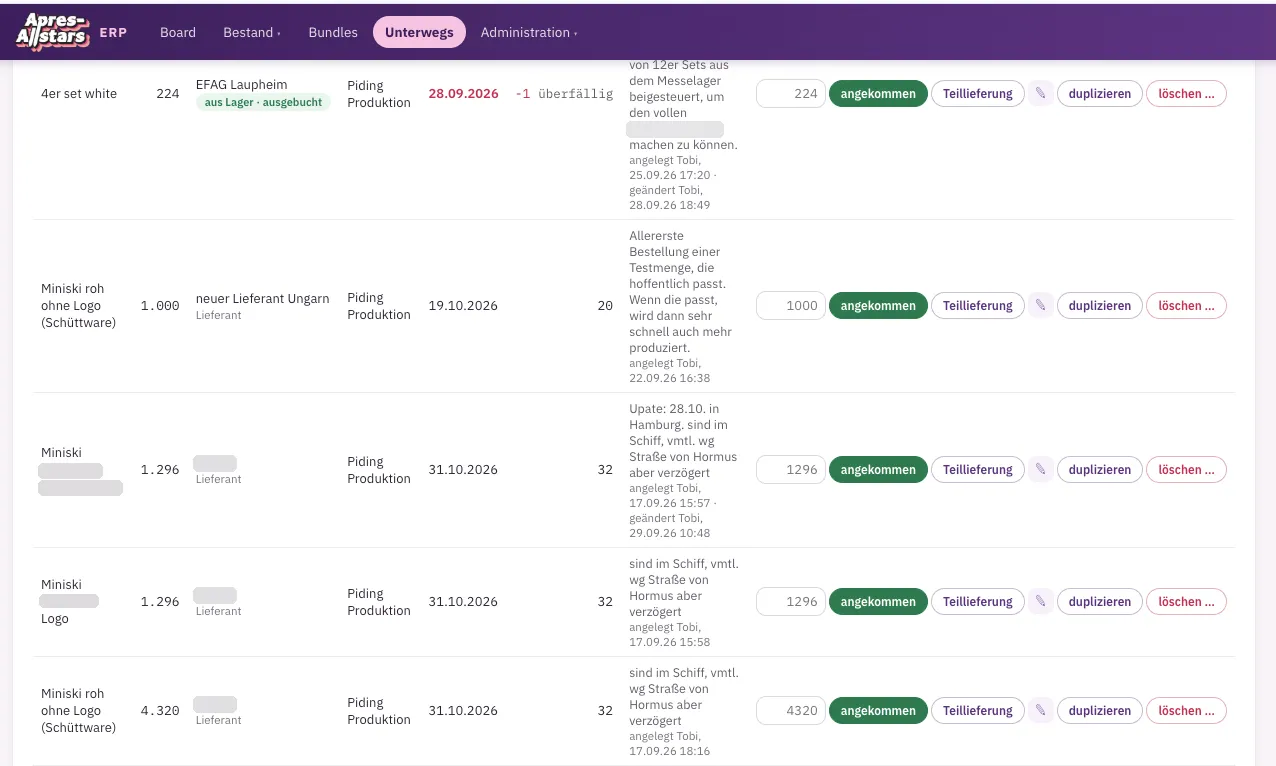
05 · In transit
What has been ordered and when it arrives
Everything on its way from a supplier or between two warehouses: quantity, from where, to where, expected date and days remaining.
Overdue deliveries turn red
On arrival, one click on “arrived” or “partial delivery” is enough
Comments with history: who changed what, and when
ERP · In transit
Real screenshots from the running system (user interface in German). Customer and supplier names have been made unrecognisable.
Your business does not need this system.
It needs the one building block from it that eats the most time in your company. Which one that is, and what it is worth in euros, is what we find out on the Test Bench.
I don’t talk about process optimisation. I rebuilt my own manufacturing business with it – and I’ll show you.
ERP for my own business
Orders, stock, invoices, suppliers – in one system that works exactly the way the business works. Built entirely by myself, because no off-the-shelf system fitted.
Screenshot coming · Receipt bot – bookkeeping that sorts itself
Receipt bot – bookkeeping that sorts itself
Reads inboxes, recognises receipts, matches them to transactions and hands them over to the accountants. Developed together with Michi Gasteiger, in production in two companies.
● in production in 2 companies
References
What people say who have worked with me
“Working with Einfallsschmiede was extremely pleasant, above all because communication was so clear from the start. We were able to move the product forward quickly and test it on the market. Gladly again!”
Marius Keckeisen CEO & President, Blackroll®
“Our product development challenges were understood immediately and implemented professionally. We were particularly impressed by the fast CAD design, which matched our ideas exactly after just a few prototype generations.”
Patrick Longin Managing Director, Pets Nature
“I value Tobi Deckert’s ability to get things done. The exchange and the mutual introductions to our network partners have greatly accelerated the progress of our projects.”
Christopher Fuhrhop Founder & CEO, RESTUBE GmbH
The Test Bench on site
One day in your business – by the evening you know how much the solution saves or adds in revenue.
Two days of work, zero risk: you only pay once you know the number – and only if it adds up for you.
First, a 20-minute call: Do you make or sell products? How many people? Which process hurts the most?
freeDay 1
The Test Bench
Analysis on site
I come to your business and walk through the one process with the people who do it every day. Numbers, routes, exceptions – everything that isn’t in a spreadsheet.
freeDay 2
The Solution
Solution and estimate
I build the solution and do the maths. By the evening you have two pages: what it saves or adds in revenue, in euros – and a clear no if it isn’t worth it.
fixed priceDay 3
The Installation
Installation and handover
The solution goes into your business: integration, data, training your people, documentation. At the fixed price agreed on day 2.
The one-third guarantee
You pay at most one third of what the solution saves or earns you. If that doesn’t add up, you get no offer – just an honest no. The fixed price is set at the end of day 2, before you buy anything.
On day 1 you see my own ERP, my bookkeeping and my shop live – that’s how my business has been running for years.