

Germany e-invoicing 2027 for manufacturers
Germany e-invoicing mandate 2027: from 1 January you must issue e-invoices if 2026 turnover exceeded €800,000. What manufacturers check and why process matters.
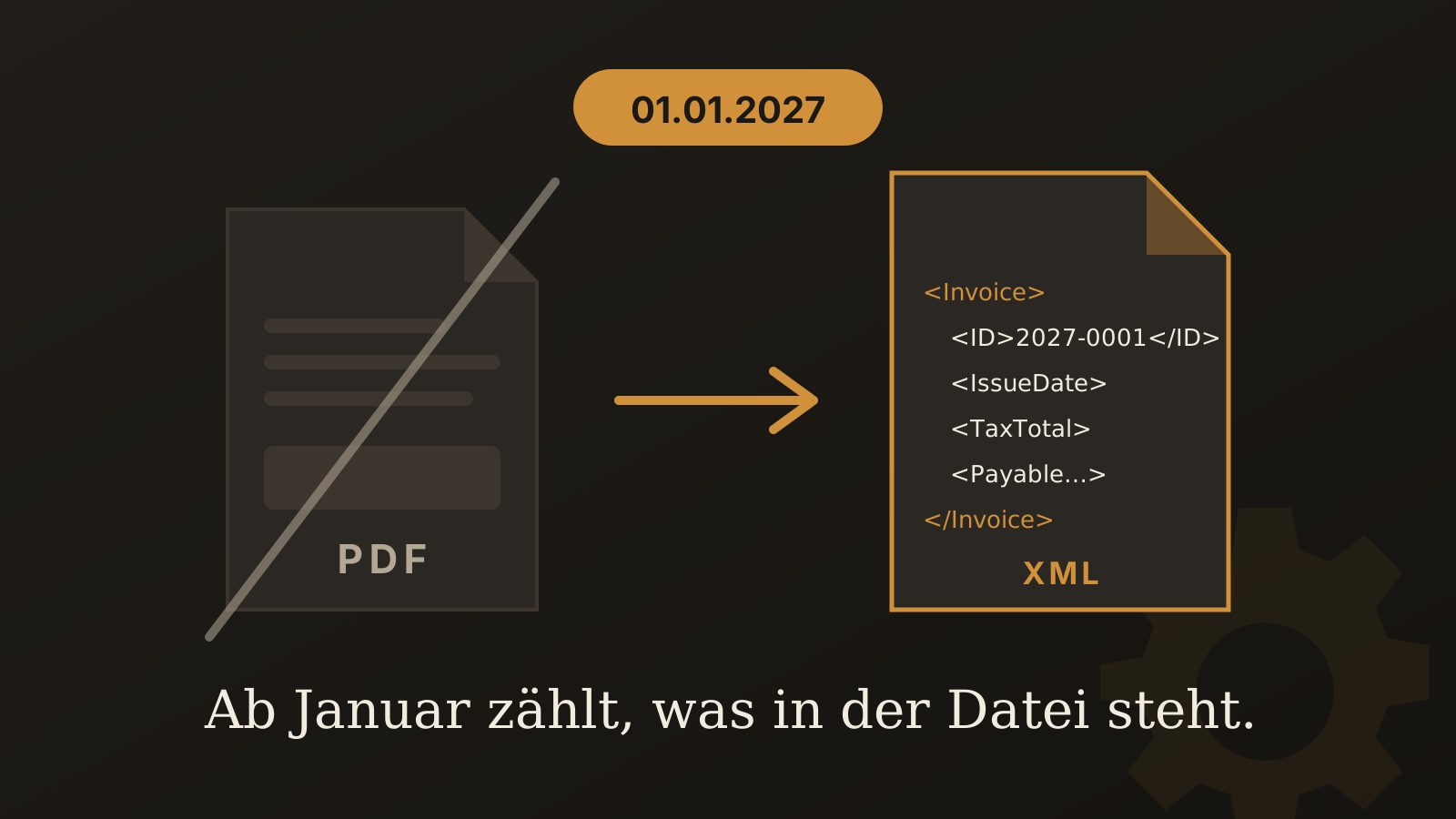
Under the Germany e-invoicing mandate 2027, what counts on many invoices from January is no longer what you can see but what is in the file. Most guides to e-invoicing in Germany explain formats and deadlines and stop there. What interests me is what comes next: invoices that arrive as data and could move on without anyone retyping them, if the process behind them is in place.
What is the Germany e-invoicing mandate 2027? From 1 January 2027, businesses established in Germany whose total turnover in the previous year exceeded €800,000 must issue invoices to other domestic businesses as e-invoices. An e-invoice (E-Rechnung) is a structured file that follows the European standard EN 16931, for example XRechnung or ZUGFeRD from version 2.0.1 (except in the MINIMUM and BASIC-WL profiles). A PDF does not count. From 1 January 2028, the mandate applies to all businesses, with a few exceptions.
💡 By the way: if you want to rebuild your invoicing process while you make the switch, I’ll help you with exactly that. How it works →
Germany e-invoicing mandate 2027: who must issue e-invoices, and when
You have to issue e-invoices from 1 January 2027 if your total turnover in 2026 exceeded €800,000 and you sell to another business in Germany. If it didn’t, you still have a grace period for supplies made in 2027, but none from 2028. The mandate only applies if you and your customer are both established in Germany.
| When | What applies |
|---|---|
| Since 1 January 2025 | Receiving: every business established in Germany must be able to accept e-invoices. An email inbox is enough for this. |
| Until 31 December 2026 | Invoices for supplies made up to the end of 2026 that you issue by this date may still be sent on paper or, with the recipient's consent, in another electronic format such as PDF. |
| From 1 January 2027 | Obligation to issue e-invoices if total turnover in the previous year exceeded €800,000. If yours didn't, you may still invoice supplies made in 2027 the same way as in 2026. |
| Until 31 December 2027 | Invoices exchanged via EDI remain permitted with the recipient's consent, even if they don't meet the standard. After that, only if the data can be converted into the standard format. |
| From 1 January 2028 | Obligation to issue e-invoices for all other businesses in Germany, with a few exceptions (see below). |
Wherever possible, invoice your 2026 supplies while it’s still December. Whether a PDF is still enough in January 2027 for something you supplied in December is disputed. Going by the wording of the law, only an e-invoice keeps you on the safe side, regardless of your turnover.
I wouldn’t wait for a postponement. The German Confederation of Skilled Crafts (Zentralverband des Deutschen Handwerks, ZDH) has been calling for one since summer 2026, but nothing has been decided. The BMF letter of 15 October 2026 (guidance from the Federal Ministry of Finance) changes many details, but it changes nothing about the statutory start dates in 2027 and 2028.
Whether you’re over the threshold depends on your total turnover in 2026, not on the size of your team. To put that in perspective: with ten employees, the €800,000 turnover threshold works out at €80,000 per head. Check your 2026 figure with your tax adviser; this article is general information and does not replace tax advice.
What an e-invoice is – and why your PDF no longer counts as one
An e-invoice is an XML file that software can read without any human involvement. A PDF, on the other hand, is a document for people to look at, and for tax purposes it only counts as an “other invoice” (sonstige Rechnung).
In practice you’ll come across two formats:
- XRechnung: pure XML, hardly readable for people without a viewer.
- ZUGFeRD from version 2.0.1: a PDF with an embedded XML file, in other words a hybrid. The MINIMUM and BASIC-WL profiles are not enough because they don’t meet the standard.
With the hybrid, the XML takes precedence. If the PDF part says something different from the XML, the XML is what counts. If you currently touch up the invoice layout by hand and leave the data in the system as it is, from 2027 you’ll be sending invoices whose valid part doesn’t match what people see. Manual fixes like these are exactly what I look for first in process optimisation.
A few cases remain exempt even after 2027, including small-value invoices up to €250 gross, invoices from small businesses under the small business scheme (Kleinunternehmer) and travel tickets. For these, an “other invoice” is always permitted.
You have to keep invoices for eight years, and for an e-invoice that means the structured part in its original form. A printed-out PDF in a folder isn’t enough for that. The GoBD, the German rules for proper digital bookkeeping and record-keeping, apply as well.
What the BMF letter of 15 October 2026 clarifies for manufacturers
The BMF letter of 15 October 2026 eases the special cases that come up a lot in a manufacturing business: final invoices after an advance payment, gross prices and minor errors in the file. And it says what you risk if a PDF goes out instead of an e-invoice.
Advance payments and interim payments. If you issued an advance payment invoice or an interim invoice before your mandate started, it didn’t have to be an e-invoice. For the final invoice, until 30 June 2030 the tax office will not object if the advance payments already made are only deducted as a total in the structured part (field BT-113). The details, such as the net amount and the VAT, then go in the free-text field BT-22 or in an embedded attachment. If you sell custom-made products with an advance payment, give both field numbers to your software provider and do a trial run of one final invoice.
Gross-price invoices. If you invoice using gross prices, the tax office will not object to e-invoices you issue by 31 December 2027 that only show the totals per VAT rate, with the VAT amount, in the structured part. The individual line items then go into an embedded attachment.
Errors in the file. If the file breaks one of the standard’s business rules, it is still an e-invoice as long as there is no format error. But if the error concerns a mandatory detail, such as the VAT amount, the date of supply or the description of the goods or services, the invoice is incorrect. That takes some of the pressure off the first few weeks; you still have to check the mandatory details.
Consequences. If you issue an “other invoice”, such as a PDF, instead of an e-invoice, the BMF says this is not an administrative offence. You don’t face a fine for that; if you issue no invoice at all, however, you can still face one. But an invoice in the wrong format is not a proper invoice, which puts your customer’s input VAT deduction at risk. It can be corrected with an e-invoice that refers to the original invoice. So the pressure is more likely to come from your customers’ accounts departments than from the tax office.
Outgoing invoices: can your system generate e-invoices?
Whether you meet the mandate is decided by the system your invoices are created in: your invoicing software, inventory management system or ERP has to generate the XML in line with EN 16931. A nice PDF template won’t help you there.
For Apres Allstars I built the ERP myself because no off-the-shelf system fitted our processes. Bought or self-built, these five questions show whether your system is ready:
- Format: Does your system generate XRechnung or ZUGFeRD from version 2.0.1 – from the data, rather than from the PDF after the fact? For ZUGFeRD it has to be at least the BASIC profile, with EN 16931 the usual choice; MINIMUM and BASIC-WL are not enough.
- Master data: Are customer addresses, tax numbers and payment terms complete in the system? Anything someone adds to the layout by hand today will be missing from the XML.
- Advance payments: Which open orders with an advance payment will only get their final invoice after your mandate starts? Run one of them through from start to finish.
- Sending: How do your biggest customers want to receive e-invoices? Receiving them by email is enough, but your customer also has to be able to process the XML.
- Archive: Is the XML filed in its original form, and does it stay retrievable for eight years?
Before the turn of the year, send a test invoice to a regular customer and to your tax adviser. A call asking “Is the file getting through to you?” takes ten minutes and can save you invoices bouncing back in January. And if, while going through this, you notice that nobody really knows who touches an invoice at which point: that’s the process I look at with your people on the Test Bench.
Incoming invoices: why structured invoices can lighten the load on your back office
On the incoming side, the e-invoice helps you more than on the outgoing side. Since 2025 you’ve had to be able to receive e-invoices, and from 2027 suppliers established in Germany whose turnover in the previous year exceeded €800,000 have to send them to you. The amount, date, invoice number and line items are then in the file as data and no longer have to be read from an image.
At Apres Allstars, the receipt bot collects invoices from several sources, matches them to the bank transactions and has been delivering them to our accountants since August 2026. I show the process step by step in the article on the receipt bot.
The question for your incoming invoices: does your receipt tool read the XML, or only the PDF image? Because the XML takes precedence, it’s the XML that should go into your bookkeeping, not whatever text recognition found in the PDF.
Approval is the step people tend to forget: whoever has to check a pure XRechnung needs a viewer or a view in your own system. Otherwise the file just sits in the inbox.
Meet the mandate or automate your invoicing process
You meet the mandate with the right format. You only save time when you build the process behind it at the same time. As soon as invoices flow as data in both directions, retyping can disappear at several points. A process that has been properly written down once can be switched to a new format; one that only exists in one person’s head can’t. Why fixed processes come before growth is covered in the article on the scaling phase.
An example for incoming invoices: a supplier invoice arrives as XML, is matched against the purchase order, goes for approval to the person who placed the order, and then ends up with the accountants together with the document. On the outgoing side, the invoice is created from the order, goes out as a file, and the incoming payment is matched to it. If, in your business, the invoice is still printed out, retyped and emailed round for approval today: that is not an IT problem. It is a process that was never built.
That’s how I approach process optimisation: not the whole company, but the one process that costs the most, walked through with the people who do it every day. Then we work out whether a tool pays off. If the number is too small, I say so and we leave it.
The starting point is the Test Bench: one day in your business and one day for the solution and estimate, both free of charge. The fixed price is set at the end of day 2, before you buy anything. The one-third guarantee: you pay at most one third of what the solution saves or earns you.
If you can get the format sorted on your own by January, the check questions above are enough. If, on the other hand, the whole invoicing process is stuck, now is a good time to build it properly, once.
Frequently asked questions
Which turnover counts towards the €800,000 threshold?
What matters is your total turnover under section 19(2) of the German VAT Act (UStG) in the previous year, so for 2027 it’s your turnover from 2026. This means the turnover of the whole business, not just your business with corporate customers; what you sell to private customers in Germany through your shop counts too. If it exceeded €800,000, you have to issue e-invoices from 1 January 2027. What counts in your particular case is something to clarify with your tax adviser.
Can I still send PDF invoices from 2027?
For supplies from 2027 onwards to business customers in Germany, only if your total turnover in 2026 did not exceed €800,000, and then only with the recipient’s consent. It’s safest to invoice supplies made in 2026 while it’s still 2026. From 2028, nobody may send a PDF instead of an e-invoice any more. Exceptions remain for small amounts up to €250 gross, invoices from small businesses under the small business scheme (Kleinunternehmer) and travel tickets, among others.
XRechnung or ZUGFeRD: which format should I use?
Both meet the mandate as long as they comply with the EN 16931 standard, which for ZUGFeRD means from version 2.0.1 and not in the MINIMUM or BASIC-WL profiles. The difference is in how they are handled: with ZUGFeRD your customer sees a normal PDF and their software reads the embedded XML. An XRechnung is pure XML and needs a viewer to be read. If your system can do both, go by what your biggest customers can process.
What applies to advance payment and interim invoices?
Advance payment and interim invoices that you issue before your mandate begins don’t have to be e-invoices. For the final invoice, a non-objection rule applies until 30 June 2030: the advance payments already made may be shown as a total in field BT-113, with the details in the free-text field BT-22 or in an embedded attachment. That’s what the BMF letter of 15 October 2026 says.
Are there penalties if I don’t issue e-invoices?
If you issue an “other invoice”, such as a PDF, instead of an e-invoice, you don’t face a fine for it, according to the BMF letter of 15 October 2026. Not issuing an invoice at all, on the other hand, can cost you a fine. But an invoice in the wrong format is not a proper invoice, and that puts your customer’s input VAT deduction at risk. So expect your customers to follow up and ask for an e-invoice that corrects the old invoice.
Do I also need e-invoices for business with Austria?
No, the German e-invoicing mandate only applies if you and your customer are both established in Germany. That also works the other way round: if your business is based in Salzburg and you have no permanent establishment in Germany, the mandate doesn’t affect you even with customers in Bavaria; a German VAT registration alone does not change that. Austria itself has no general mandate for electronic invoicing between businesses. Only those who supply federal government bodies there have had to invoice them electronically in a structured format since 1 January 2014; for suppliers from abroad, this only applies where technically possible.
Sources
Federal Ministry of Finance (BMF): questions and answers on the e-invoice (as of March 2026, in German) · German VAT Act (UStG), Section 14(1), (2) sentence 2 no. 1 and (5) sentence 2, Section 14b(1), Section 19(2), Section 26a and Section 27(38) nos. 1–3, in the version applicable from 1 January 2025 · German VAT Implementing Ordinance (UStDV), Section 33 sentence 4, Section 34(1) sentence 2 and Section 34a · BMF letter of 15 October 2025 on the introduction of mandatory e-invoicing · VAT Application Decree (UStAE), Section 15.2a(1) and (1a) · BMF letter of 15 October 2026, III C 5 - S 7287-a/00019/021/017 (paras. 2–4, 17–19, 22–23, 28) · EN 16931-1 (fields BT-22, BT-113) · GoBD, BMF letter of 28 November 2019, last amended on 14 July 2025 · German Confederation of Skilled Crafts (ZDH, zdh.de): ZDH kompakt on postponing the e-invoicing mandate to 1 January 2028 (in German) · Austrian Business Service Portal (USP, usp.gv.at): e-Rechnung (in German); Section 5 IKTKonG. As of 30 October 2026. This information is general and does not replace tax advice.
Is your business stuck right here? That's what I solve →